“I don’t want to do it. What if I get it wrong?”
Most parents have heard some version of this. It might come before a difficult maths problem, while learning a new sport, or when a child is unsure about raising their hand in class. Fear of being wrong can become so strong that children stop trying before they have had a chance to learn.
A growth mindset in children is the belief that abilities can develop through practice, useful feedback and different strategies. Mistakes provide information about what to try next rather than proving that a child is incapable. Parents and schools can help by making room for questions, revision and another attempt.
When Being Right Becomes More Important Than Learning
Children naturally enjoy correct answers, good scores and winning. The challenge begins when children start believing that being good at something means getting it right immediately.
A more helpful question is not “Am I good at this?”, but “How can I get better at this?” That shift leaves room for effort, feedback, experimentation and another attempt. It also helps children see learning as something they take part in, rather than a judgement that is settled after one result.
Carol Dweck’s research at Stanford University helped draw attention to how children’s beliefs about ability can influence the way they respond to challenge. A growth mindset does not suggest that effort alone guarantees success; effective strategies, guidance, time and suitable support matter too.
Why the Second Attempt Matters
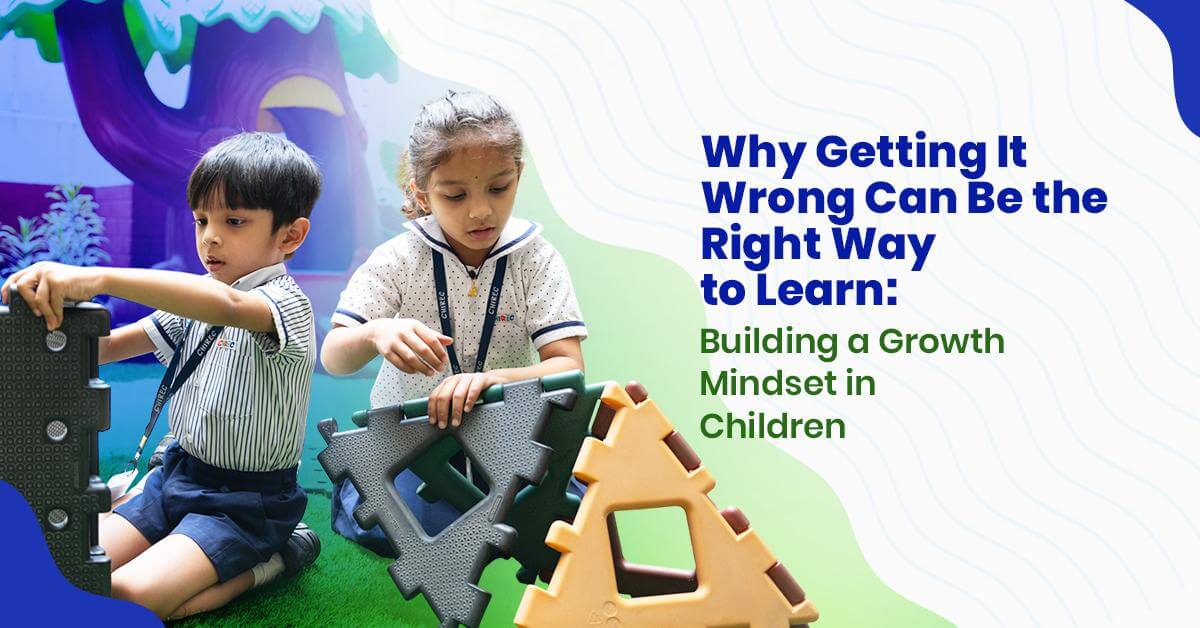
Learning to ride a bicycle rarely happens in one smooth attempt. A child may wobble, lose balance, put their feet down, understand something about what happened and try again with small adjustment. Nobody expects the first attempt to be perfect.
Learning in the classroom can work in much the same way.
The same pattern appears in first drafts, experiments and problem-solving. Children develop questioning, adaptability, confidence in uncertainty, self-regulation and collaboration when they ask what happened, consider feedback and decide what to change.
A successful first idea and an unsuccessful first idea can each provide useful information when children reflect and improve. The value lies not simply in success or failure, but in what the child notices and does next.
How Parents Can Build a Growth Mindset at Home
You can help your child develop a growth mindset through small everyday conversations:
- Ask, “What did you try?” instead of only asking whether the answer was correct.
- Encourage your child to try a different method when the first one does not work.
- Talk about mistakes calmly instead of treating them as something embarrassing.
- Praise specific actions, such as checking work, asking for help or changing a strategy.
- Give support when needed but allow your child to do the thinking and trying.
These habits help children see mistakes as part of learning rather than as a verdict on their ability.
How Schools Make Room for Trial and Error
At CHIREC, one way students experience this process is through Project-Based Learning.
Rather than always beginning with a question that has one predetermined answer, students can start with an open-ended problem. They research, connect information from different subjects, discuss possibilities and develop solutions.
For example, one CHIREC project around sports brought together English with areas such as mathematics, history and social studies. Students researched sports including cricket, hockey, mountaineering, handball and scuba diving before developing their own game ideas and strategies.
Through questioning, researching, discussing, reconsidering and improving, students practise collaboration, adaptability, confidence in uncertainty and self-regulation. An idea that does not work can still give students useful information for the next attempt.
When an Idea Meets the Real World
The same principle becomes even clearer when students have to solve problems beyond a conventional classroom exercise.
Through CHIREC’s Student Entrepreneurship Programme with DLabs at the Indian School of Business, students have had opportunities to take ideas through a process of questioning, testing and refinement.
Student teams worked with mentors to identify genuine problems, understand customer needs, think about solutions and consider whether their ideas could actually work.
That means confronting questions such as: Does someone really need this? What assumptions have we made? Is there another way to solve the problem?
An idea becoming stronger because somebody challenged it is an important lesson in itself. It teaches students that feedback is not necessarily a judgement on their ability. It can be information that helps them make the next attempt better.
Growth Mindset, Perseverance and Resilience
Growth mindset, perseverance and resilience are connected, but they are not the same thing.
- Growth mindset: the belief that abilities can develop.
- Perseverance: continuing to work through difficulty.
- Resilience: recovering after disappointment and finding a way forward.
A growth mindset helps children believe that they can improve. Perseverance helps them continue when a task is difficult. Resilience helps them recover when they feel disappointed or when an attempt does not work.
Children do not need to keep trying without support. They may need a new strategy, clearer guidance, a break or help from an adult. Supporting perseverance does not mean asking children to push through every difficulty alone. It means helping them understand what they can try next.
Teaching children the value of perseverance can help parents frame difficulty as something that may require patience and more than one approach. Helping children deal with academic stress also requires attention to rest, emotional support, realistic expectations and appropriate help. A child should not feel that needing support means they lack determination.
What Should Parents Look for in a School?
Parents comparing schools in Hyderabad may consider curriculum, academic outcomes, facilities and opportunities.
There is another question worth considering:
What happens when my child gets something wrong here?
- Does the learning environment reward only correct answers, or are students encouraged to explain how they arrived at an answer?
- Can they revise work after receiving feedback?
- Are they given opportunities to experiment, create, debate and solve problems that may not have an obvious answer?
How teachers and schools respond to mistakes can influence how children eventually respond to challenges themselves.
What to Say When Your Child Makes a Mistake
| Instead of saying | Try saying |
| “Why did you get this wrong?” | “Can you see where it started going wrong?” |
| “Do not make a mistake.” | “Let us see what the first attempt tells us.” |
| “Here, let me do it.” | “What else could you try?” |
| “You should have known that.” | “What would you do differently next time?” |
The aim is not to turn every mistake into a lesson. It is to move conversations from judgement towards reflection, while also allowing children to feel disappointed, tired or frustrated without immediately having to explain the experience.
Getting It Wrong Is Not the Opposite of Learning
One of the most useful things children can discover at school is that they do not have to know everything before they begin.
They can ask questions. They can attempt something difficult. They can get stuck. They can seek help, reconsider and try again.
A child who becomes comfortable with that process is not learning to accept failure. They are learning how to respond when success does not come on the first attempt.
As children move from classrooms into higher education, careers and a world that will keep presenting unfamiliar problems, there will not always be an answer key.
Knowing how to get things right matters. Knowing what to do when they get something wrong may matter even more.
What is a growth mindset in children?
It is the belief that abilities can develop through practice, feedback and different strategies. It does not mean every child can achieve every outcome through effort alone.
Why are mistakes important for learning?
Mistakes show where understanding or strategy needs attention and give children information for revising their approach, especially when they are encouraged to reflect rather than feel ashamed.
How should parents respond when a child is afraid of being wrong?
Acknowledge the worry, reduce the pressure to be perfect, ask what part feels difficult and invite one manageable next attempt. Avoid rushing to solve it or dismissing the fear.
Does praising effort always help?
No. Praise should be specific and connected to useful actions such as persistence, checking, changing strategy or seeking feedback, while recognising that effort needs to be paired with effective methods.
How can schools encourage children to learn from mistakes?
Schools can provide clear feedback, allow revision, use open-ended tasks, discuss errors respectfully and assess the thinking process as well as the final answer.
For parents, the practical takeaway is simple. During a school visit, look for evidence that students can receive feedback and improve work; at home, ask what your child noticed, what they might try after and what support would help. These small habits reflect the way growth mindset in children and learning from mistakes are approached at CHIREC International School.