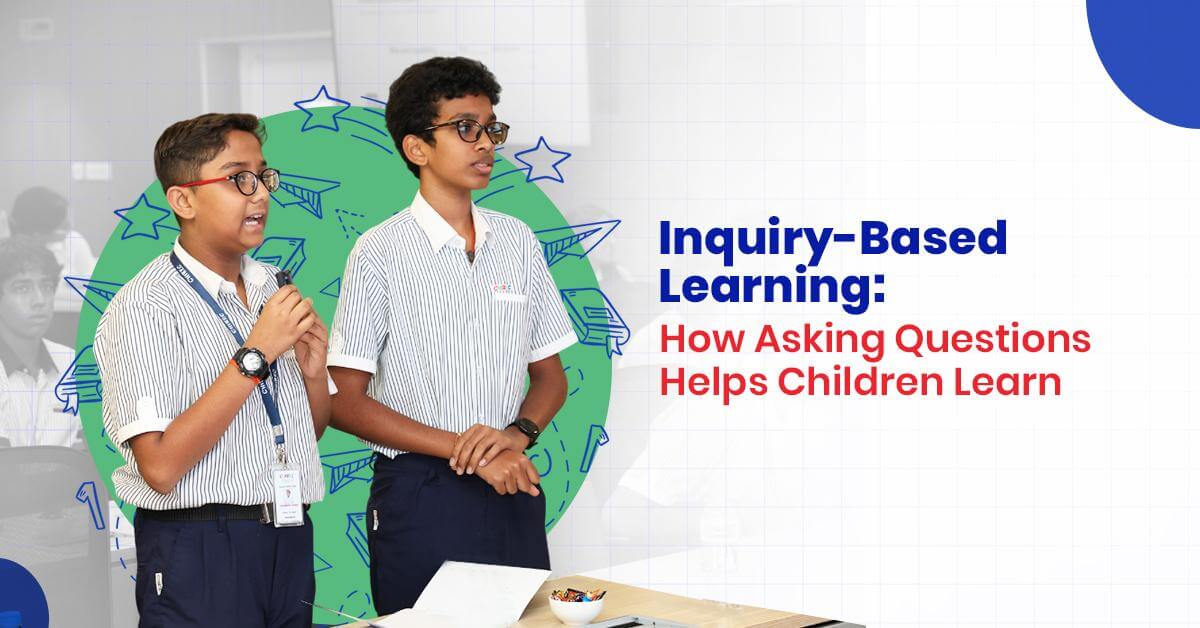
Inquiry-Based Learning: How Asking Questions Helps Children Learn
Children ask questions from a very young age. They want to know how things work, why something happens and what might happen if something changes. As they grow older, their questions may become more detailed, but curiosity remains an important part of how they learn.
At school, students need to understand concepts, remember information and solve problems. They also need to recognise when something is not clear and know how to explore it further.
This is where inquiry-based learning can help. It encourages children to ask questions, investigate information, consider different viewpoints and use what they learn to develop their own understanding.
What Is Inquiry-Based Learning?
Inquiry-based learning is an approach in which students use questions, research, investigation and discussion to understand a topic more deeply.
Instead of only receiving information and memorising answers, students are encouraged to explore questions such as:
- Why does the moon appear to change shape?
- What would happen if part of an experiment were changed?
- Why might two people describe the same historical event differently?
- How can we tell whether information is reliable?
Teachers continue to provide subject knowledge, instruction and guidance. The difference is that students also have opportunities to use that knowledge to investigate ideas, solve problems and explain their reasoning.
Inquiry-based learning does not replace strong subject knowledge. It helps students apply what they know.
How Does Inquiry-Based Learning Help Children?
Asking questions gives children a more active role in learning. It can help them:
- Understand ideas instead of only memorising information.
- Connect new learning with what they already know.
- Explore different explanations and points of view.
- Develop critical thinking and problem-solving skills.
- Become more confident when discussing their ideas.
- Learn how to research and evaluate information.
- Take greater responsibility for their own learning.
For example, a child may know that a historical event took place. Inquiry encourages them to explore why it happened, what evidence exists and how different people may have experienced it.
Similarly, a child researching a school project may find many online sources. They also need to ask who created the information, whether it is reliable and whether other sources support it.
How Is Inquiry-Based Learning Different from Rote Learning?
Rote learning involves remembering information through repetition. This can be useful for vocabulary, mathematical facts, scientific principles and other foundational knowledge.
Inquiry-based learning builds on this knowledge. It asks students to use what they know to investigate, compare, analyse and create.
For example, a student may memorise the stages of the water cycle. Through inquiry, they may go further by asking:
- How does the water cycle affect the local environment?
- What happens when rainfall patterns change?
- How could a community conserve water?
- What evidence supports the answer?
Both knowledge and inquiry have an important place in education. Children need a strong foundation before they can explore complex questions, but they also need opportunities to use that foundation independently.
How Does CHIREC Build Inquiry and Critical Thinking Skills?
CHIREC develops inquiry and critical thinking through classroom discussion, investigations, research, reflection and projects across its CBSE, Cambridge and IB programmes. The aim is to help students understand their subjects deeply while becoming more confident in asking and answering questions.
At the Serilingampally campus, the CHIREC IB Diploma Programme includes a four-day Prelude to IB Foundation Programme that introduces students to the approaches to thinking and learning they will use throughout the IBDP.
Project-Based Learning gives students another setting in which to investigate questions, plan tasks, work with information and present outcomes. Projects can connect different subjects and require students to explain not only what they found, but also how they reached their conclusions.
Through activities like these, students practise examining evidence, comparing viewpoints and explaining their reasoning. They also learn that information does not always need to be accepted at face value.
How Do Inquiry Skills Develop as Children Get Older?
Inquiry develops gradually, moving from guided curiosity in the early years to structured, research-led and evidence-based investigation in secondary school. Children need the right opportunities to question, explore and explain at every stage.
In the early years and primary years, curiosity and questioning begin through observation, talk, play and simple investigations. Teachers can help children notice patterns, make predictions and describe what they see without expecting formal research.
For secondary students, inquiry becomes more structured and research-led. Students may formulate a question, evaluate sources, compare interpretations, collect data, cite evidence and revise their conclusions when new information emerges.
This gradual development supports independent learning. Students increasingly learn to plan parts of their work, seek clarification, choose suitable resources and assess the quality of their own answers.
Why Is Critical Thinking Important for Children Today?
Critical thinking helps children decide whether information is accurate, relevant and supported by evidence. It is especially valuable when they encounter search results, social media posts, edited videos and claims produced or repeated by AI tools.
Children should learn to ask who created a piece of information, what evidence is offered, whether the source may be biased and whether other reliable sources agree. They also need to understand that a confident tone does not make a claim true.
These habits are useful beyond school. They help students make careful decisions, listen to different viewpoints, recognise misleading arguments and explain their own opinions clearly while remaining open to better evidence.
What Should Parents Look for in a School That Develops Critical Thinking?
Parents should look for a school where questioning is welcomed, subject knowledge is taught clearly and students are expected to explain their reasoning. The most useful evidence is often visible in everyday lessons, conversations and student work.
- Ask whether students investigate questions, conduct experiments or discuss more than one viewpoint.
- Look for classroom tasks that require evidence, explanation and reflection rather than only correct answers.
- Ask how the school teaches students to check sources and use information responsibly.
- Notice whether students are encouraged to ask questions and speak thoughtfully during a school visit.
It is also worth asking how inquiry is adapted for different ages and curricula. A strong approach should be clear in early years and primary classrooms as well as in secondary CBSE, Cambridge and IB learning.
How Can Parents Encourage Curiosity and Questioning at Home?
Parents can encourage inquiry by treating children’s questions as welcome starting points for conversation, not as interruptions or extra schoolwork. Everyday activities such as cooking, reading, visiting a museum or watching the weather can lead to useful discussion.
Try prompts such as: “What did you find interesting about it?”, “How did you find that out?”, “Did everyone have the same opinion?”, “Where could you find more information?” and “Is there another way of looking at it?”
When a child asks something, you cannot answer, model curiosity by saying, “Let’s find out.” Compare two sources, discuss which seems more trustworthy and explain why. The aim is not to turn every conversation into a lesson, but to make questioning, listening and checking information normal parts of family life.
————————————————————————–
Frequently Asked Questions
Why is asking questions important for students?
Asking questions helps students clarify what they do not understand, connect new information with existing knowledge and explore subjects in greater depth. It can also encourage active participation rather than relying only on information provided by a teacher.
What is inquiry-based learning?
Inquiry-based learning is an approach in which students use questions, research, investigation and discussion to develop their understanding of a topic. Teachers continue to provide instruction and guidance while giving students opportunities to explore ideas and reach informed conclusions.
How does inquiry-based learning develop critical thinking?
Inquiry-based activities often require students to compare information, examine evidence, consider different perspectives and explain their reasoning. Practising these skills helps students assess information more carefully before reaching a conclusion.
How can parents encourage children to ask better questions?
Parents can give children time to explain their thinking, ask them how they reached an answer and encourage them to investigate topics they are curious about. Discussing books, current events, school projects and everyday experiences can also provide natural opportunities for questions.
How does CHIREC encourage inquiry-based learning?
CHIREC provides opportunities for inquiry through approaches such as Project-Based Learning and its IB learning experience at the Serilingampally campus. Activities including research, discussion, source evaluation and open-ended projects encourage students to investigate information and develop their own understanding.