How Schools Help Students Develop Real-World Problem-Solving Skills
A student notices that the school canteen generates a lot of food waste and suggests turning leftovers into compost.
It sounds like a good idea. But where would the compost go? Who would separate the waste? How much space would be needed? And could the school maintain the process?
These questions take the student beyond simply suggesting an idea. They encourage them to understand the problem, gather information, consider different options and work out whether a solution is practical.
This is what real-world problem-solving in education is about. Children learn to use what they know, ask better questions and make decisions based on information rather than assumptions.
Why Are Problem-Solving Skills Important for Students?
In a classroom exercise, students may be given a clearly defined question and asked to find the correct answer. Real-life situations are often different. They may have incomplete information, several possible solutions and limitations that need to be considered.
Consider a school trying to reduce plastic waste. Students might suggest replacing disposable bottles, installing water refill stations or encouraging reusable containers.
Each option raises practical questions about cost, convenience, maintenance and how people would use it.
Working through these considerations helps students develop skills such as:
- Critical thinking: Examining information and questioning assumptions.
- Research: Gathering evidence before making decisions.
- Creativity: Considering different ways to approach a problem.
- Collaboration: Listening to ideas and working towards shared solutions.
- Decision-making: Comparing options and understanding their limitations.
These skills are useful in academic work, group activities and everyday situations.
How Do Schools Develop Problem-Solving Skills in Students?
Children need opportunities to do more than listen to explanations or follow instructions. They need to investigate questions, try different approaches and explain why they have chosen a particular solution.
Schools can make this part of learning through activities such as:
- Open-ended questions: Students explore questions that may have more than one possible answer.
- Experiments and investigations: They observe what happens, record findings and use evidence to draw conclusions.
- Group projects: They share responsibilities, discuss different viewpoints and work towards a common outcome.
- Practical challenges: They design, build or test something and make changes based on what they discover.
For example, if students are asked to find a better way to organise classroom books, they could first observe how the existing shelves are used. They might then sketch different layouts, create a simple model and ask classmates to try it. Their final design may be quite different from their first idea.
That is part of learning to solve problems: understanding that an initial suggestion is a starting point, not always the final answer.
What Is Design Thinking, and How Does It Help Students?
Design thinking is a structured approach to solving problems by understanding people’s needs, exploring possible solutions and testing ideas.
Students can work through five broad stages:
- Understand: Observe the situation and speak to the people affected.
- Define: Identify the specific problem that needs attention.
- Explore: Suggest different ways to address it.
- Create: Develop a model, prototype or early version of a solution.
- Test and improve: Gather feedback and make changes.
This process teaches students to look beyond their first assumptions. They learn that a solution should work for the people who will use it, not just look good on paper.
Testing also helps children understand that a design that does not work as expected is not necessarily a failed attempt. It gives them information about what needs to change.
How CHIREC Gives Students Opportunities to Apply Their Ideas
At CHIREC International School, students get opportunities to connect classroom learning with practical challenges through Project-Based Learning, the Innovation Hub and the Student Entrepreneurship Programme.
Learning Through the Student Entrepreneurship Programme with ISB
CHIREC’s Student Entrepreneurship Programme, conducted in collaboration with DLabs at the Indian School of Business (ISB), gives high school students an opportunity to explore how ideas can develop into viable ventures.
Now in its third edition, launched in August 2026, the programme has brought together 80+ students from CHIREC’s Kondapur and Serilingampally campuses. Through workshops and mentorship sessions, students are learning about design thinking, identifying customer needs, financial planning and developing business proposals.
As they work on their ideas, students are encouraged to look beyond the concept itself. Who is the idea intended to help? Does it address a genuine need? What resources would be required to make it work? Working through these questions helps them examine the practicality of their ideas and consider how they could develop them further.
The programme is now building towards its Demo Day on 28 November 2026, when students will present their ideas and the progress they have made.
Watch our students at work: View the programme in action on Instagram
How Can Parents Encourage Problem-Solving at Home?
Children do not need specialised equipment or formal projects to practise problem-solving. Everyday situations can offer plenty of opportunities.
If your child regularly misplaces school supplies, ask them to suggest a better way to organise their belongings. When planning a family outing, an older child could compare travel options or estimate costs. Even deciding how to divide household tasks can involve planning and discussion.
Try asking:
- What problem are you trying to solve?
- Why do you think this idea will work?
- What would you need to try it?
- Is there another way to approach it?
- How could you find out whether it worked?
The level of responsibility should suit the child’s age. Younger children may need simple choices and demonstrations, while older children can research options and explain their decisions.
The aim is not to solve every problem for them, but to give them room to think, try and learn with guidance when they need it.
What Should Parents Look for in a School That Develops Problem-Solving Skills?
When exploring schools, parents can look beyond facilities and ask how students actually use what is available to them.
Here are a few useful questions to ask during a school visit:
- Do students work on projects that involve real questions or practical challenges?
- Are they encouraged to explain their ideas and consider different viewpoints?
- Do they get opportunities to research, experiment, build or test their solutions?
- How do teachers guide students when an approach does not work?
- Can the school share examples of student projects or initiatives?
The answers can help parents understand whether problem-solving is part of everyday learning or limited to occasional activities.
At CHIREC, approaches such as Project-Based Learning and the Student Entrepreneurship Programme with ISB give students different opportunities to investigate ideas and consider how they could work in practice.
From an Idea to a Practical Solution
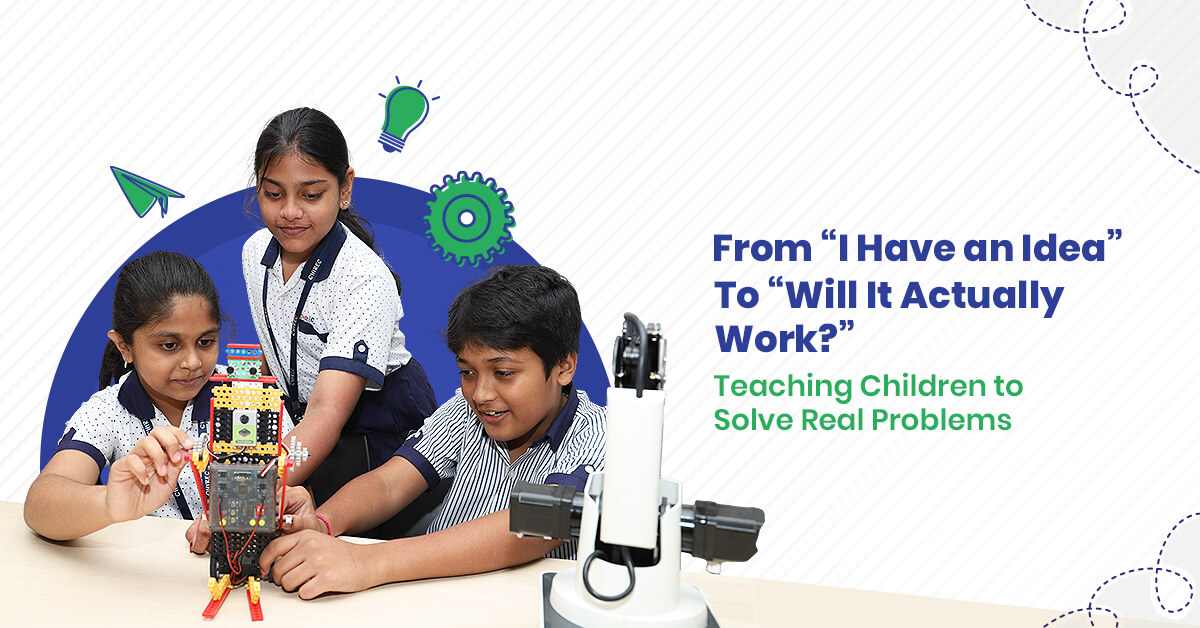
A good idea is often only the beginning. Students also need to understand the problem, consider who is affected, gather information and work out what a practical solution might involve.
When schools give children opportunities to question, research, collaborate and test their thinking, they learn to approach challenges with greater care and independence.
The aim is not for every student idea to become a finished product or a successful venture. It is for students to learn how to think through a problem, explain their decisions and keep improving an approach when the first attempt does not work.
Frequently Asked Questions
- What are real-world problem-solving skills for students?
Real-world problem-solving skills help students identify challenges, gather information, compare possible solutions and make decisions based on practical considerations. They involve critical thinking, creativity, research and collaboration.
- How can schools develop problem-solving skills in children?
Schools can develop problem-solving skills through project-based learning, experiments, design challenges, group activities and practical assignments. These experiences give students opportunities to investigate questions, test ideas and explain their decisions.
- What is design thinking for students?
Design thinking is an approach to problem-solving that involves understanding people’s needs, defining a problem, exploring ideas, creating prototypes and improving solutions through feedback.
- How does project-based learning improve problem-solving skills?
Project-Based Learning encourages students to investigate open-ended questions, conduct research and apply knowledge from different subjects. They learn to organise information, work with others and develop solutions supported by evidence.
- How does entrepreneurship education benefit school students?
Entrepreneurship education helps students understand customer needs, assess ideas, plan resources and consider whether a proposed solution is practical. It also gives them opportunities to develop communication, research, collaboration and decision-making skills.