The world has never been easier to keep up with. It has also never been more difficult to understand.
A student can wake up to news of a conflict halfway across the world, scroll past a debate on climate change, watch a reel about Artificial Intelligence, and finish breakfast after seeing five completely different opinions on the same issue. Everyone has something to say. Knowing who to listen to, and why, is far more complicated.
That is where schools have an important role to play.
Education today isn’t only about preparing students for examinations. It is about helping them ask thoughtful questions, examine different perspectives and have conversations with people who don’t always think like they do.
That is exactly what Model United Nations, better known as MUN, encourages.
What is MUN and Why Does It Matter?
At its core, Model United Nations (MUN) is a simulation of the United Nations. Students step into the shoes of diplomats, represent assigned countries, debate international issues, negotiate with other delegates and work together to draft resolutions.
Unlike a conventional debate, MUN asks students to set aside their personal opinions and represent the official position of the country they have been assigned. They speak for the country they represent, which means they need to understand the country’s history, priorities, policies and relationships before stepping into the committee room. Sometimes, they even defend viewpoints that are very different from their own.
The experience goes far beyond public speaking. It asks students to research deeply, think critically, work with people who hold different opinions and respond thoughtfully under pressure. While doing all this, they learn that winning arguments is not the aim, rather it is important to listen carefully, ask better questions and find common ground.
These skills matter far beyond an MUN conference. Whether students go on to study engineering, law, medicine, business or humanities, they will need to analyse information, communicate well and collaborate with people from different backgrounds.
A Tradition of Dialogue at CHIREC
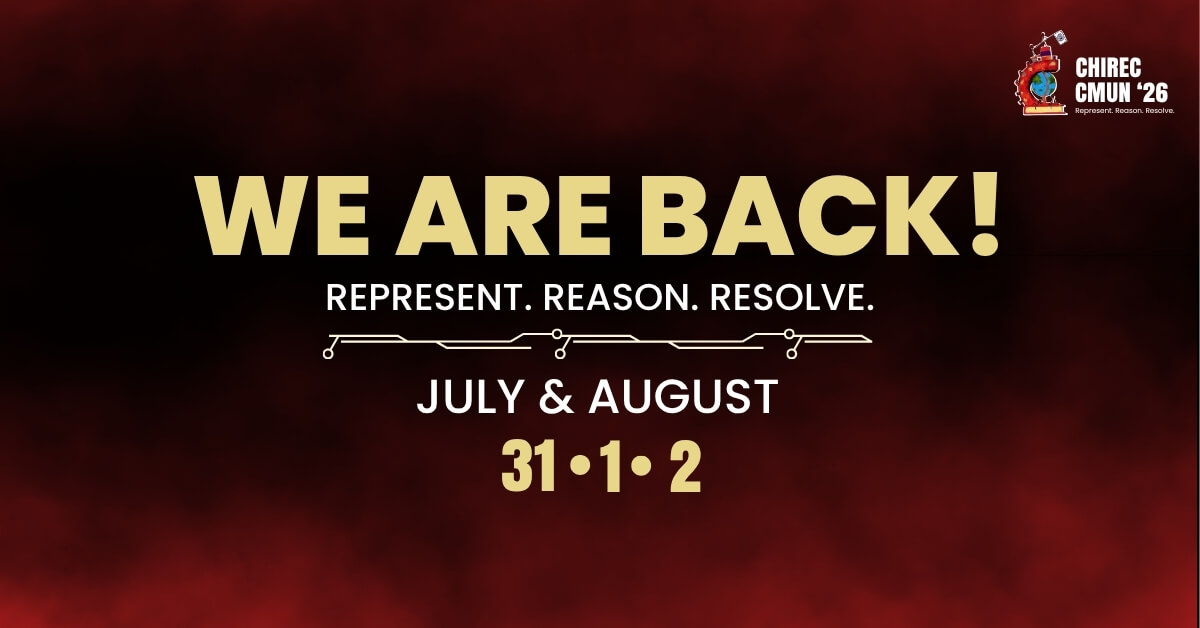
For more than a decade, Model United Nations has been an important part of student life at CHIREC International School. This year marks the 14th edition of CHIREC MUN, bringing together young delegates for three days of discussion, negotiation and diplomacy across 13 committees from 31 July to 2 August 2026.
Every edition welcomes a mix of first-time delegates and experienced participants. Some students walk into their first committee unsure of when to raise their placard. Others return as committee members and student leaders, guiding younger delegates through their first conference. That exchange between experience and fresh perspectives has become one of the defining features of CHIREC MUN.
Across every committee, students are encouraged to look beyond headlines, understand why countries make the choices they do and appreciate that complex problems rarely have simple answers.
By the end of the conference, delegates leave with far more than awards or certificates. They leave having learned how to build an argument with evidence, negotiate respectfully, speak with confidence and, perhaps most importantly, change their minds when presented with a better idea.
As preparations begin for this year’s conference, CHIREC MUN continues to give students something that feels increasingly valuable today, that is, a space where listening matters just as much as speaking and where dialogue always comes before disagreement.
To know more about this year’s conference, visit the CHIREC MUN website or follow @chirecmun on Instagram for committee announcements and conference updates.