When Parents Step into the Classroom, Children Sometimes Become the Teachers
Parents see a lot of their child’s school life from outside. They hear about a lesson at the dinner table, look through a notebook, attend a parent-teacher meeting, and often watch their child’s performance from the audience. But there are things parents understand differently when they become part of the learning experience themselves.
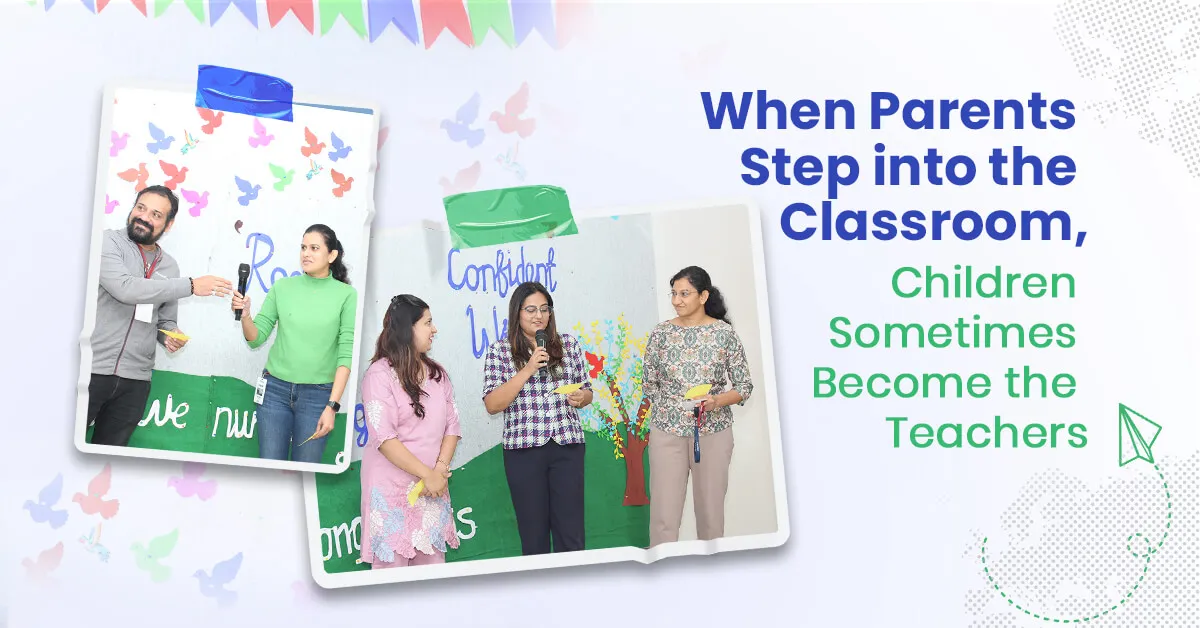
That is one of the reasons Parent Collaborative Activities (PCA) are part of primary school life at CHIREC. Held from 12 to 20 August, across the Gachibowli and Kondapur campuses, the sessions brought parents into the learning experience rather than keeping them as observers.
How Parent Involvement Supports Children’s Learning
The idea of bringing families closer to children’s learning is reflected in India’s National Curriculum Framework for the Foundational Stage. It describes families as children’s first teachers and says that schools and families share responsibility for supporting children’s learning and development. It also encourages schools and families to work together to better understand the child.
Recent research from India points in a similar direction. A 2026 study published in Oxford Development Studies, using data from the India Human Development Survey, found a positive association between parental involvement and children’s learning outcomes. The study looked at forms of involvement such as attending parent-teacher meetings, discussing schoolwork with teachers and supervising homework.
So, where does a PCA fit in?
Parent involvement in children’s education can take many forms. At CHIREC, PCA offers one of them: parents get to experience learning alongside their children and see how they communicate, collaborate and respond to a task.
Learning Through Play: Parents and Children Learning Together
For Grades I and II, the focus was on Indian traditional games. Children and parents played together while revisiting games that have been part of Indian childhood for generations.
The activities gave students opportunities to practise turn-taking, patience, cooperation, communication and sportsmanship. For parents, it was also an opportunity to see how these skills can develop naturally through play and interaction.
Teaching Children Responsible Choices Through Sustainability
Grade III turned sustainability into the Recycling Ranger Carnival. Through activities and challenges, students demonstrated what they had learnt about reducing waste, reusing resources and recycling responsibly.
Parents participated alongside them and were encouraged to think about how these choices can become part of everyday life at home. The experience connected classroom learning with decisions children and families make outside school, while also encouraging teamwork, problem-solving and responsible decision-making.
Supporting Children’s Emotional Well-Being and Independence
For Grade IV, Roots & Wings: Growing Together focused on children’s emotional well-being and the relationship between independence and security.
Parents reflected on the importance of listening, empathy, encouragement and positive communication. The session explored a question many families encounter as children grow: how do we give children a strong sense of belonging while also giving them the confidence to make decisions and become more independent?
It was a conversation that connected school learning with something much closer to everyday family life: how children learn to understand themselves, relate to others and gradually take responsibility for their choices.
Seeing Home Through a Child’s Eyes
Grade V combined Parent Collaboration with World Photography Day through Through My Lens: Home, Memories & Me.
Students and parents used photographs to talk about home, memories, relationships and experiences that have become part of their lives. A photograph became a starting point for conversation, allowing children to share what certain moments mean to them and parents to see familiar memories from their child’s perspective.
The activity showed how learning can begin with something as familiar as a family photograph and lead to conversations about identity, belonging and relationships.
The Role of Social-Emotional Learning in Primary Education
Although the themes differed across Grades I to V, social-emotional learning in schools was common to every PCA session.
Ms. Sumita, Head of SEL, conducted sessions for parents across the primary grades, explaining how self-awareness, emotional regulation, empathy, communication, relationship-building and responsible decision-making are developed through everyday experiences at school.
At CHIREC, SEL is not treated as a separate lesson. It is part of how students interact, solve problems, manage emotions and work with others.
The PCA sessions gave parents a closer view of that approach. They could see the connection between the activities their children were participating in and the skills the school is consciously working to develop.
What Parent Collaboration Can Continue Beyond School
The value of parent-school collaboration doesn’t end when a PCA session does.
When parents understand more about what their children are learning and how they are learning it, it can open up more meaningful conversations at home. A traditional game can lead to a conversation about cooperation. A recycling activity can influence a family’s everyday choices. A photograph can prompt a child to tell a story that a parent may not have heard before.
That is what makes Parent Collaborative Activities useful beyond the event itself. They give parents a window into their children’s learning and give children an opportunity to explain, demonstrate and sometimes lead.
For CHIREC, the aim is not only to bring parents into school for an activity. It is to strengthen the connection between school, home and the child, so that learning feels relevant in both places.